
Five for Friday – May 8, 2026
Profits, Firings, Risks, Sell?, and On This Day
A specific type of anxiety can come from a gap between what is expected and what is happening. With gas prices high, conflict in Iran lingering, and other woes omnipresent in the news, it might be unsettling that stock markets are at all-time highs. But the stock market is not the economy, nor is it the headlines; it is a (small-ish) group of companies whose share prices over time reflect the profitability of their businesses. And business is booming. With about 75% of S&P 500 firms having already reported earnings for the first quarter, profits are tracking to be up 28% year over year, the biggest jump since 2021. Perhaps even more striking, the S&P 500’s profit margin (how much of each dollar in sales is left over after paying every expense) is tracking at 14.7%, which would be the best since at least 2009. Strong fundamentals don’t render the market immune to selloffs, nor is that strength guaranteed to last. But in the past, neither bear markets nor recessions have tended to happen when profitability is as robust as it is today.
2. Firings
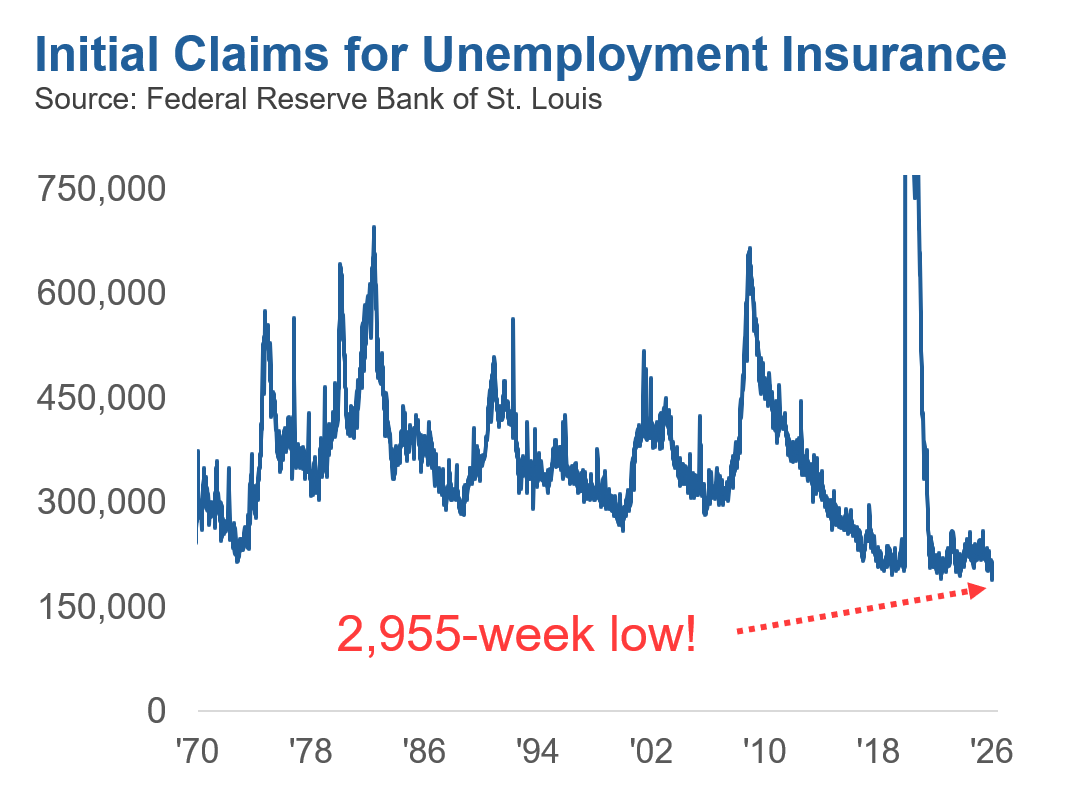
Amid the noisy discourse on the the impact of AI on the labor market, my north star has been initial claims for unemployment insurance. This data is high frequency (weekly) and high quality (administrative filings rather than survey data), which make it useful in assessing whether layoffs are actually ramping up. And despite all of the AI headlines, initial claims hit a 57-year low last week. Whatever U.S. companies are doing with AI, it has not yet resulted in economically significant layoffs (and, separately, some of the high profile AI layoffs to date may have been companies citing “AI efficiencies” to justify layoffs that would have occurred anyway).
3. Risks
So, where then do the risks lie? Quietly, very long-term bond yields have crept back to highs. It’s likely been too scrutinized to be a black swan type of existential risk (black swans tend to be unexpected), but higher yields have been a thorn in the side of this bull market since it began four years ago. Higher energy prices paired with other inflationary pressures have put the Federal Reserve in a bind and removed all expectations of rate cuts from the next year’s forecast, while long-term rates are also reflecting deficit and debt worries. And it isn’t just a U.S. problem – this week, UK yields hit their highest level since 1998 and Japanese bond yields continue their uninterrupted upward ascent (recall the 2024 market sell-off catalyzed in part by Japanese bonds). A nice hunting ground for bond investors, but a potential irritant for stockholders.
4. Sell?
Arriving alongside May flowers is the annual discourse around the “Sell in May and go away” investing strategy. The persistence of this adage (despite ample evidence it doesn’t work) says more about our fondness for rhymes than anything else. And while the stretch from May to October has indeed been the weakest six month period over the last 75 years (though the average return is still +3.6%), the last few years bucked the trend (+24% in 2025, +14% in 2024). In fact, over the last decade, the six-month period ending in October (what the rhyme says to avoid) has seen a higher average return than the six-month period ending in April. Seasonal patterns can be useful, but they don’t outweigh bigger drivers, and missing a double-digit return in just a six month stretch is far from a good way to build wealth.
5. On This Day
in 1980, the WHO declared smallpox – one of the deadliest infections ever – eradicated. To date, it is the only human disease officially eradicated globally, and stands as one of the great examples of ingenuity, innovation, and coordination. Progress isn’t always linear, but the smallpox campaign stands as proof that humans can solve “unsolvable” problems, even in difficult times. Pessimism might look smart, but optimism is what compounds over time.
Disclosures
This is not a complete analysis of every material fact regarding any company, industry or security. The opinions expressed here reflect our judgment at this date and are subject to change. The information has been obtained from sources we consider to be reliable, but we cannot guarantee the accuracy. Market and economic statistics, unless otherwise cited, are from data provider FactSet.
This report does not provide recipients with information or advice that is sufficient on which to base an investment decision. This report does not take into account the specific investment objectives, financial situation, or need of any particular client and may not be suitable for all types of investors. Recipients should not consider the contents of this report as a single factor in making an investment decision. Additional fundamental and other analyses would be required to make an investment decision about any individual security identified in this report.
For investment advice specific to your situation, or for additional information, please contact your Baird Financial Advisor and/or your tax or legal advisor.
Past performance is not indicative of future results and diversification does not ensure a profit or protect against loss. All investments carry some level of risk, including loss of principal. An investment cannot be made directly in an index.
Copyright 2026 Robert W. Baird & Co. Incorporated.
Other Disclosures
UK disclosure requirements for the purpose of distributing this research into the UK and other countries for which Robert W. Baird Limited holds an ISD passport.
This report is for distribution into the United Kingdom only to persons who fall within Article 19 or Article 49(2) of the Financial Services and Markets Act 2000 (financial promotion) order 2001 being persons who are investment professionals and may not be distributed to private clients. Issued in the United Kingdom by Robert W. Baird Limited, which has an office at Finsbury Circus House, 15 Finsbury Circus, London EC2M 7EB, and is a company authorized and regulated by the Financial Conduct Authority. For the purposes of the Financial Conduct Authority requirements, this investment research report is classified as objective.
Robert W. Baird Limited ("RWBL") is exempt from the requirement to hold an Australian financial services license. RWBL is regulated by the Financial Conduct Authority ("FCA") under UK laws and those laws may differ from Australian laws. This document has been prepared in accordance with FCA requirements and not Australian laws.


